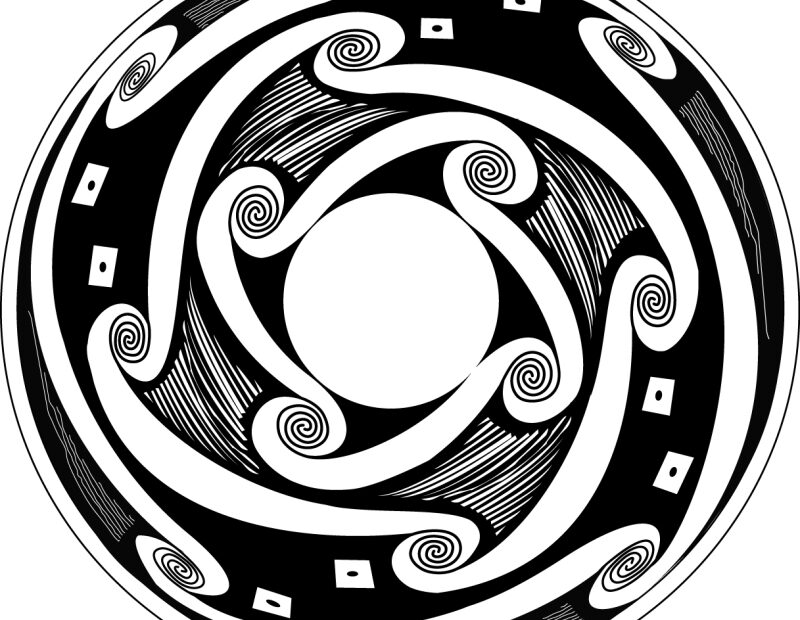
For years, individual archaeologists have proposed that the blue-green color of turquoise was represented by the fine lines (aka hachure) in certain styles of Mimbres bowls, presumably as an appeal for water. Later archaeological study suggested that “…Mimbres hachure was likely representative of color but not necessarily blue-green. In fact, it may have referenced yellow. Yellow and blue are often paired among the Pueblos, and [there may have been] interregional differences in the meaning….”
Stephanie Whittlesey carried these findings further.
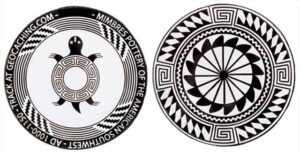
She discovered that even more colors of the spectrum could be produced from certain Mimbres designs. She wrote in 2014 for the journal Kiva (vol. 80:1 at pp. 45-70) that “…Many Mimbres black-on-white bowls painted with geometric designs produce the illusion of color when rotated rapidly, much like the subjective-color hallucination that has been known in the psychology of perception for more than a century…” Whittlesey also explained, “…Subjective color is one of several elementary visual hallucinations with similar patterns that are produced by a variety of stimuli….They are universal in human beings and offer clues to neural modeling…
“…I argue that the illusion was deliberately produced by Mimbres potters and may have been used by shamans to induce trance states or in mimetic rituals to bring rain….”
Here’s how Whittlesey describes the process: “…[A] bowl can be rotated by floating it in a larger bowl filled with water and spinning it with a stick. This method provides the fastest rotation. Another technique that works well is to affix the bowl bottom to a sherd or puki with a bit of damp clay and spin it with the hands like a top….With a little practice, bowls also can be rotated on a relatively smooth surface using just the fingers. Subjective color has been observed in demonstrations using all of these methods. The color effect has been observed outdoors in indirect sunlight and at night with only firelight for illumination. Electricity is clearly not a requirement to produce the effect….”
Read Stephanie Whhittlesey’s whole article here. It is riveting.
Whittlesey advises in her final footnote: “Readers may observe subjective color as follows. Photocopy and enlarge any disk or pottery design that produces subjective color, paste to a cardboard disk, and punch a hole through the center to insert a small dowel, pencil, or chopstick. Spin like a top and see the colors emerge.”
[Ed. note: Although the GCAS encourages anyone to photocopy a Mimbres design and stick it on a pencil to spin around, the GCAS absolutely, positively does not endorse the use of such a contraption while under the influence of a migraine, epileptic event, or perception-enhancing substances of any kind whatsoever, ever ever ever.]