Anytime is a terrific time to join the GCAS! Membership runs from January through December of the current year. Our individual membership is $20 and our family membership is $30. Click Here to join online via our PayPal link; or if you’re Old Skool, you can download, print, fill out our Membership form, and send it with a check by mail to: Grant County Archaeological Society, PO Box 1713, Silver City, NM 88062. Thank you for joining us!
Fill your calendar by scrolling down through all these upcoming events. Plan ahead but be mindful that any of the following events may be postponed or cancelled on very short notice for any number of weather-related or other reasons.
Watch this Events Page for details on our GCAS general meetings, held in-person or alternatively online via Zoom.
Mimbres Archaeological Research and Education Center (MAREC)

Please visit the GCAS at the Mimbres Archaeological Research and Education Center (MAREC) located in the historic Wood House at the Mimbres Culture Heritage Site. The GCAS is working in our library and lab/workroom in the Wood House’s ground floor. We welcome donations and volunteers so that we may continue expanding and improving the GCAS’s resource materials and educational programs. If you’d like to volunteer email us for ideas of the projects and events where we need you the most. [Photo: Mattocks Site/Mimbres Culture Heritage Site. Wood House, center. © Mitchell Clinton, Mitchell Clinton Photography. All Rights Reserved.]
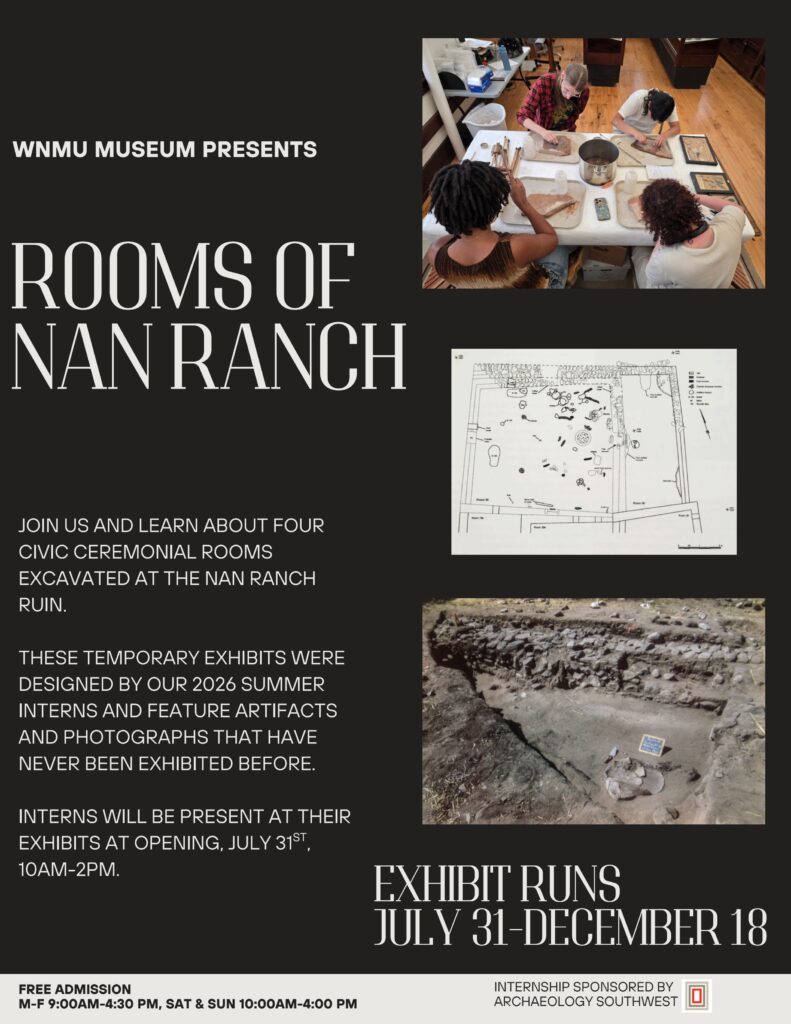
Now thru December 18, 2026: “Rooms of the NAN Ranch” Exhibit at WNMU Museum
The 2026 summer interns trained by Archaeology Southwest and the WNMU Museum prepared an exhibit of never-before-seen artifacts and photographs from four civic-ceremonial rooms at the NAN Ranch archaeological site.
Next GCAS Meeting: Wednesday, September 16, 2026: (ONLINE ONLY – Zoom info below):
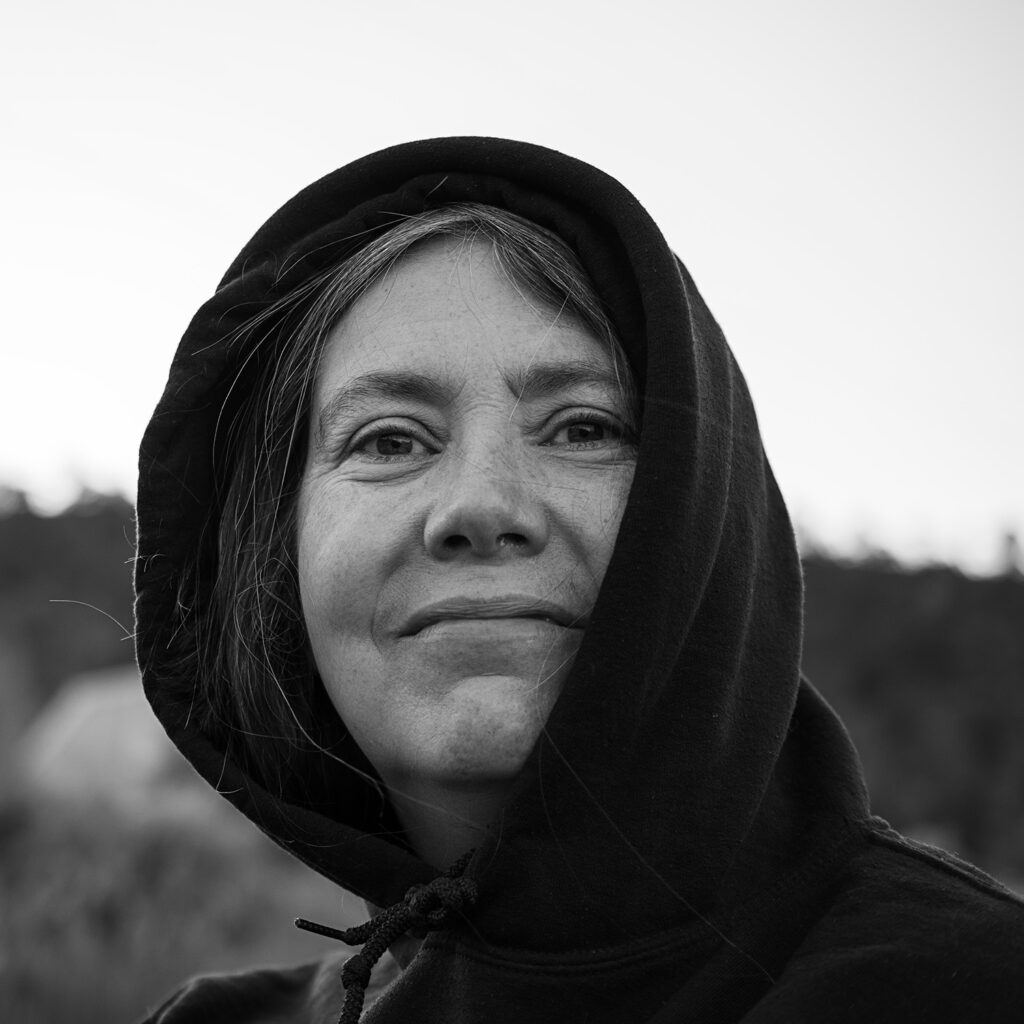
A short business meeting at 6:00 pm will be followed by a Zoom presentation given by Emily Lena Jones, Professor of Anthropology at the University of New Mexico, entitled ” The Zooarchaeology of the West Baker Site: Exploring Mimbres Human-Animal Relationships Outside the Mimbres Heartland.” West Baker (LA 83574) is a Classic Mimbres site located nearly 100 km southwest of the Mimbres valley. Excavated in 1964 but never analyzed or published, the collections from this site have been the subject of a recent effort, led by archaeologists Patricia Gilman and Thatcher Selzer-Rogers, to bring this unusual site to light. As part of this project, Dr. Jones analyzed the animal remains collected by the original excavators. The West Baker zooarchaeological assemblage is robust enough to provide some insight into how people at this site interacted with the animals in the region—and how their interactions may have differed from those of people living in the Mimbres heartland. In this talk, Dr. Jones will discuss the West Baker faunal assemblage and what it suggests about hunting, tool-making, and other activities at this unusual site.
Emily Lena Jones is Professor of Anthropology and Regents’ Lecturer at the University of New Mexico. A zooarchaeologist and environmental archaeologist, her research focuses on the connections between the human-animal relationship and environmental change across time and space. Most recently, her work has focused on the Columbian exchange in central New Mexico, a topic that is the focus of a forthcoming book from University of New Mexico Press.
Join Zoom Meeting (Members and friends can get on early to chat …. about 5:40 or so.)
https://us06web.zoom.us/j/83210906871?pwd=m19mpOIbiWoOudq16ju5A3Yblm3zCr.1
Meeting chat link
https://us06web.zoom.us/launch/jc/83210906871
Meeting ID: 832 1090 6871
Passcode: 369276
One tap mobile
+16694449171,,83210906871#,,,,*369276# US
+16699006833,,83210906871#,,,,*369276# US (San Jose)
Join by SIP
83210906871@zoomcrc.com
Join instructions
https://us06web.zoom.us/meetings/83210906871/invitations?signature=fpWmZpK0O3LSkG_GVX_ymusghP1ilSz3WJ3xcn-J6jg
Next GCAS Field Trip: October 8, 9 and 10 (no September field trip). October’s field trip will be to the Mogollon conference at the New Mexico State University Museum in Las Cruces – see below.
Thursday, October 8 through Saturday, October 10, 2026, in Las Cruces NM: the 23d biennial Mogollon Archaeology Conference happens at NMSU’s Corbett Center Auditorium and University Museum. Pre-register from now through September 26, 2026, for $60/person ($35/student) to be assured of obtaining a ticket (an extra $35/person and $25/student) for the Friday evening banquet as space is limited. Post-September 26 rates are $70/person and $35/student. Registration forms and many other details are on the Conference’s very handy website at https://lonjul.net/MogollonAC2026/
Tuesday & Wednesday, October 13 & 14, 2026: “Training on Looting, Vandalism and the Archaeological Resources Protection Act”
This two-day training class, offered by the Jornada Research Institute, combines classroom instruction and field applications covering major legislation (including the Archaeological Resources Protection Act), legal and criminal frameworks, case studies, and damage assessment procedures, with field instruction in assessing and recording site damage. The course qualifies for New Mexico Historic Preservation’s continuing credit program on an hour-per-hour basis. Participants can expect to learn the statute, the importance of site-record databases, how to identify signs of looting, isolating, recording, and mapping damaged areas, developing site looting episode chronologies, writing a field damage assessment, and recommending steps for site protection. JRI provides binders and zip files with ARPA regulations, case studies, field assessment reports, and PowerPoint files, site information for field exercise, field forms and instruction sheets, and clipboards. Participants need to bring an archaeological field toolkit and camera (smartphone). $190 (JRI members and students $180) 9 am-4 pm each day at Bureau of Reclamation, 555 Broadway NE, Albuquerque. For more information and to register contact Jeffery Hanson at jefferyhanson64@gmail.com or 817-658-5544.
Wednesday, October 14, 2026, 7:00PM (MDT): “Late Middle Archaic and Early Agricultural Period in Southern Arizona: Materials from McEuen Cave”
A free online (or in-person in Durango, CO) presentation by archaeologist Joseph Birkmann, PhD sponsored by San Juan Basin Archaeological Society. Dr. Birkmann will discuss this southeastern Arizona cave that has produced some of the oldest maize and squash in the region. For more information visit https://www.sjbas.org/field-trips-activities/.
Thursday, October 15, 2026, 7:00-8:30 PM (AZ/MST, same as PDT – Online, free): Defining the Main Plaza and Ritual Use of Space in the Ceremonial Precinct at Paquimé
Zoom presentation by archaeologist Michael D. Mathiowetz, PhD, sponsored by Old Pueblo Archaeology Center. The development of plaza-oriented pueblos across Arizona and New Mexico by the late thirteenth century was part of significant socioreligious and political changes across the region. The rise of the Casas Grandes tradition during the Medio period (1200–1450 CE) coincided with these changes, although its role in these social transformations remains poorly understood. Advances in the modeling of social, religious, and political organization at Paquimé and its regional hinterlands allow us to examine the use of public and private space at the paramount center. In this presentation, Dr. Mathiowetz identifies a previously unrecognized “Main Plaza” in Paquimé’s ceremonial precinct that may have served as a locus of public dancing linked to solar and maize ritualism in feasting contexts. If this interpretation is correct it provides a potential model for the development of plaza-pueblo ritualism in the Pueblo world of the Southwest. Dr. Mathiowetz has engaged in field surveys, excavations, and museum and archival research on the Casas Grandes and Aztatlán traditions of Northwest Mexico for two decades. To register for the Zoom webinar, Click Here. (NOTE: The Zoom registration page shows the start time in the registrant’s local time zone, so 8pm for those of us in MDT.) For more information, contact Old Pueblo at info@oldpueblo.org or 520-798-1201.
Saturday, October 17, 2026, 9:00 AM – 2:00 PM: World Archaeology Day will be celebrated at the WNMU Museum
November 10-18, 2026: Jornada Region Tour
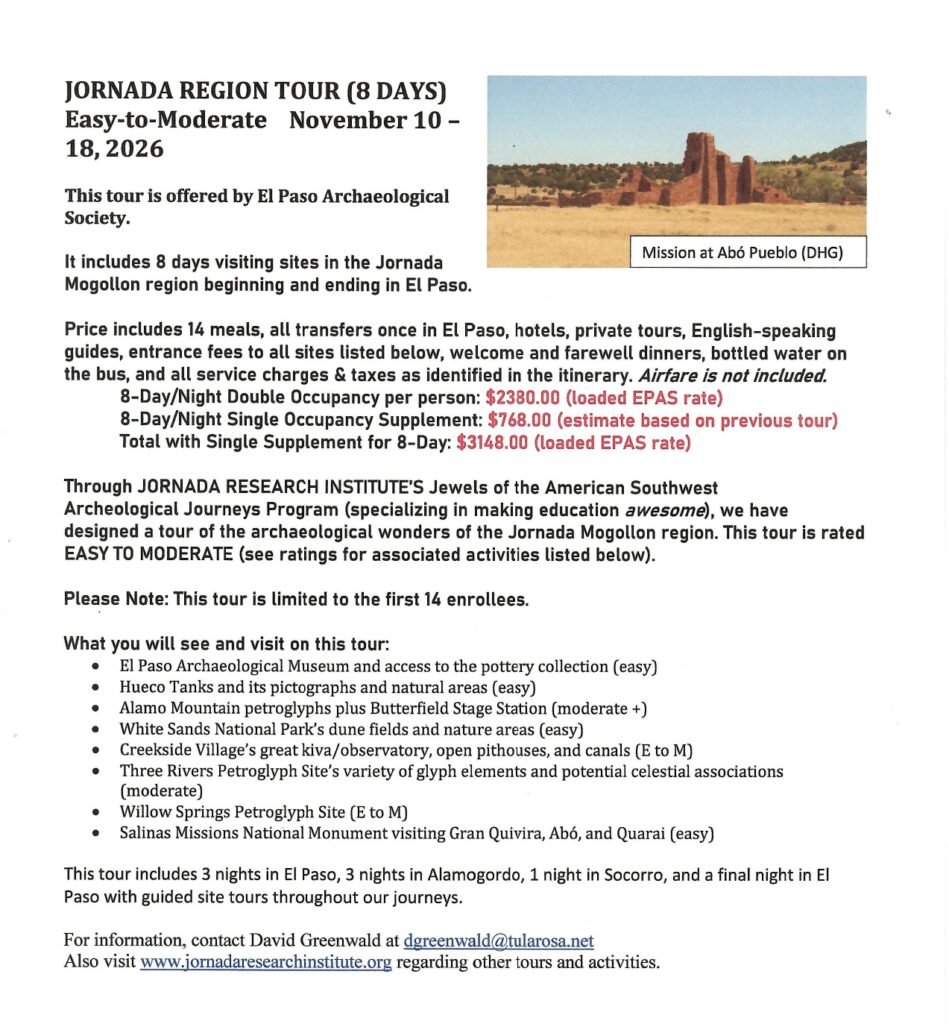
For information, contact David Greenwald at dgreenwald@tularosa.net
Wednesdays, January 20-May 19, 2027, 6:30-8:30 pm AZ/MST (Online): “Archaeology of the Southwest” 18-session online adult education class
“Archaeology of the Southwest” is an introductory course that provides a basic overview of the US Southwest’s ancestral cultures. Expanding this year from 14 to 18 evening class sessions, it will cover cultural sequences, dating systems, subsistence strategies, development of urbanization, depopulation of different areas at different times, and the general characteristics of major cultural groups that have lived in the Southwest over the past 13,000-plus years. Besides offering an up-to-date synthesis of Southwest cultures for anyone interested in the archaeology of the Southwest, the class can be taken for certification in the Arizona Archaeological Society (AAS) Certification/Education Program. (It is a prerequisite for certification in all of the AAS’s other courses offered.) Instructor Allen Dart is a registered professional archaeologist and executive director of Old Pueblo Archaeology Center. $145 donation ($115 for Old Pueblo Archaeology Center, Arizona Archaeological Society [AAS], and Arizona Site Stewards members). Donation does not include cost of the recommended text. Donations are due 10 days after reservation request or by 5 pm Monday January 18, whichever is earlier. To register or for more information contact Old Pueblo at info@oldpueblo.org or 520-798-1201.
There are even more online and in-person events happening all over the place. Make it a regular habit to check out what the following organizations offer the avocational archaeologist:
American Rock Art Research Association (ARARA)
The Archaeological Conservancy posts recorded lectures on YouTube and on their website’s event page after the event occurs. Visit them for this and lots more information, and follow them on their Facebook page.
Archaeological Society of New Mexico
Archaeology Southwest: Things To Do, and More Things To Do
The Arizona Archaeological and Historical Society produced a virtual field trip of the Mattocks Site and Mimbres Culture Heritage Site on February 5, 2022, which is now available via the AAHS’s YouTube channel. Click here and enjoy as Marilyn Markel and Professor Emerita Pat Gilman, the supervising archaeologist for the 1970s Mattocks Site excavation, lead you through the site while discussing the future opportunities it offers for local educational programs and archaeological research.
Borderlandia offers specialized tours of the Arizona-Mexico borderland including Tubac & Tumacácori; and greater Mexico including locations such as Paquimé & Mexico City
As a member of the Council of Allied Societies, the GCAS and our members receive access to the CoAS monthly newsletter. The most recent CoAS newsletters are available by scrolling down to the bottom link entitled “Council of Allied Societies Newsletter Archives” on this page. For further CoAS doings, visit their Facebook page. GCAS members may also attend one free and one discounted online seminar; contact onlineseminars@saa.org to verify your GCAS membership and for all other details.
Crow Canyon Archaeological Center: Programs, Research, and Education
The Gila Cliff Dwellings National Monument hosts a free series of presentations at their Visitors Center where folks can meet a number of speakers giving short presentations on a variety of archaeological and cultural topics. Follow them on Facebook too!
The Jornada Research Institute – Look for JRI’s latest quarterly newsletters here. Join a JRI archaeological tour such as their upcoming 11-day tour to Egypt’s Archaeological Wonders, Museums, and Old Cairo’s Historic Area from October 24, 2026, to November 4, 2026 (waitlisted); their 2027 11-day tour to Sicily: Crossroads of the Mediterranean; and their 2028 11-day tour to the Culture and Powers of the Iberian Peninsula. Weather and schedules permitting, JRI also offers hands-on excavation activities at either the Cornelius Locus archaeological site in Ruidoso NM, or Creekside Village near Tularosa NM. Work at either site is an excellent opportunity for GCAS members to join an excavation crew to better understand archaeological excavation and preservation methods. For details, contact Dave Greenwald directly at dgreenwald@tularosa.net, visit JRI’s website, and follow the Jornada Research Institute on Facebook and Instagram for other, additional announcements and tour information.
OF SPECIAL INTEREST TO GCAS MEMBERS:
Identify your favorite 501(c)(3) charity in your JRI tour registration, and JRI will make a $125 cash donation to that charity. Coincidentally, the GCAS is a 501(c)(3) public charity. You can support two nonprofits at once! None of JRI’s Overseas Journeys is ever repeated, and tend to fill up quickly so if you are considering any of JRI’s tours, contact JRI’s Dave Greenwald ASAP for flyers, itineraries, and all other info.
Mesa Prieta Petroglyph Project: Events, Mesa Talks Lecture Series, and Tours
Mimbres Culture Heritage Site: Considering a visit to the Mimbres Culture Heritage Site? Check for events; to confirm tours and museum access telephone the MCHS directly at 575.536.3092 or 307.640.3012.
Old Pueblo Archaeology Center: at times throughout the year Old Pueblo offers multi-session online classes on a variety of topics. Click on these links for more information from Old Pueblo on these and other programs and events. Because the GCAS maintains an organizational membership with Old Pueblo, Old Pueblo offers discounts to individual GCAS members on many of their programs and events, so when signing up for an event, make a point of telling them you’re a GCAS member. Old Pueblo has also posted recordings of many of their Third Thursday Food for Thought and Indigenous Interests webinar presentations on their Youtube channel. GCAS says check them out: https://www.youtube.com/channel/UCDgPTetfOL9FHuAW49TrSig/videos.
The Pueblo Archaeological and Historical Society of Pueblo, Colorado, has regular in-person and online presentations as well as their online-accessible newsletter and YouTube channel. Check them out for these options and much more.
The Society for American Archaeology (SAA) and their affiliate, the Council of Allied Societies (CoAS) work to build meaningful relationships between professional and avocational archaeologists. They act as clearinghouses for events, programs, and volunteer opportunities to suit all tastes and abilities. Go here to access SAA’s digital versions of a variety of their regular publications. Enjoy!
Ron Barber, creator of the Stone Calendar Project, has been studying rock art sites throughout the Southwest and Northern Mexico identifying glyphs that mark specific times of the year using unique light and shadow interactions. He has some survey predictions for glyphs along the Gila Narrows and other southern sites and is looking for volunteers to help in further research. Anyone who is interested in spending time in the field recording/filming calendar sun light interactions in the region, please contact Ron directly at barbers6@aol.com.
The Texas Archaeological Society is based in San Marcos, Texas, and offers a wide variety of events and research/educational opportunities for the avocational and professional communities. Visit their website to learn how they provide support for research grants, scholarships, and more.