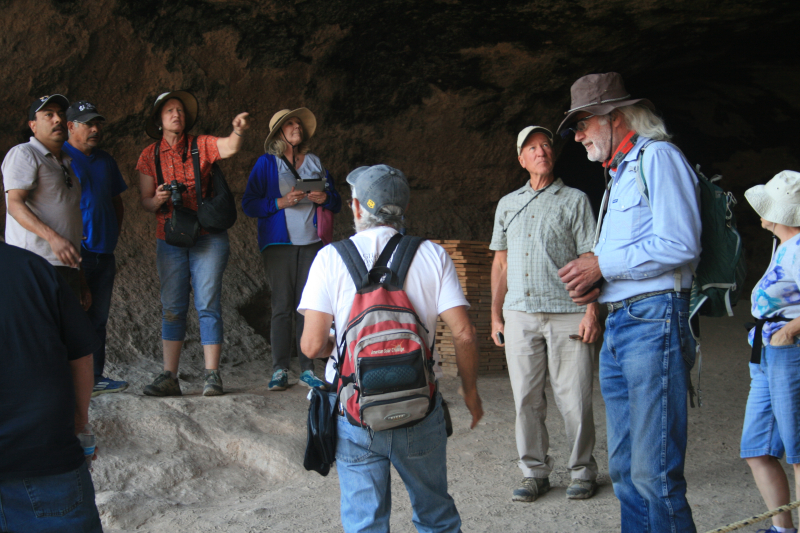

The three-day GCAS international field trip to Paquimé, Chihuahua, Mexico, May 2-4, 2018, was a great success. A total of 16 hardy souls participated: four from El Paso; one from Las Cruces; one from Santa Fe; and ten from assorted locales around Grant County, New Mexico. Our tour guide, Luis Benavidez, and his associate, Oscar, took very good care of us while introducing us to points of interest all over the place. That’s Luis, over there in that photo on the right.
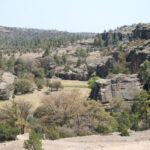
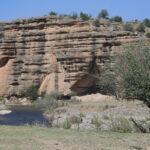
May 2 found our group in two vans, checking in with Mexican Immigration in Palomas and then riding for about three hours from there to the greater Nuevo Casas Grandes area. Our first archaeological destination of the trip was among the windswept mountains of the Sierra Madre Occidental near the town of Ignacio Zaragoza. We visited cliff dwellings in two separate cliff-side caves along the valley of the Rio Piedras Verdes. Luis explained to us that millennia ago this region was somewhat similar to the Mimbres River in New Mexico, in that archaeological sites of small groups of dwellings have been found every few miles along the river and its fertile valley. Human occupation in certain parts of this valley has been dated to 5500 BCE.
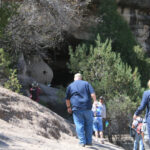
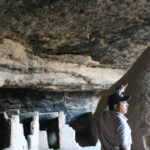
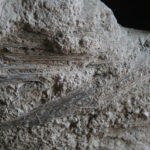
We parked the vans and took a short hike of about 1-1/4 miles to the cliff dwellings of La Cueva de la Olla, ruins notable for the immense, olla-shaped granary located there. (The far left photo shows a portion of the “olla” in the left-center of the cave’s mouth.) Similar food storage construction has been found at other sites, but this particular “olla” stands about 12 feet high and has a diameter of about 7 feet at its widest point (see middle photo). It was built of a style of adobe, with palm fronds embedded in its rounded walls (see third photo). Food could be removed or added by one of several openings in its bottom and sides, and it could be filled to the top by reaching its uppermost mouth from the upper floor or roof of the cliff dwellings. It held enough grain or herbs such as amaranth seeds, epazote leaves, guaje pods, sotol, etc., to sustain the residents during the cold mountain winters for as long as 170 days.
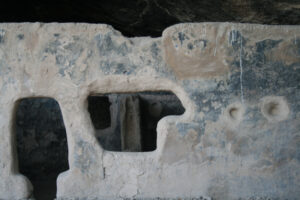
Archaeologists estimate that this site was occupied by at least 30 individuals – and their granary was in use – from about 950 CE to 1050 CE. The walls of the cliff dwellings no longer reach to the cave’s roof, but visible in the second/middle photo of the row of three shown above, are the bleached lines in the rock showing where the walls once stood. Similar to many cliff-dwelling sites throughout the US Southwest, La Cueva de la Olla’s pueblo had window/ventilation openings that were small and doorways that were narrow and T-shaped for defensive advantage. Rumor has it that the “olla” and perhaps even the walls of the cliff dwellings themselves were originally decorated with black and red paint, but if that is the case few if any traces remain today.