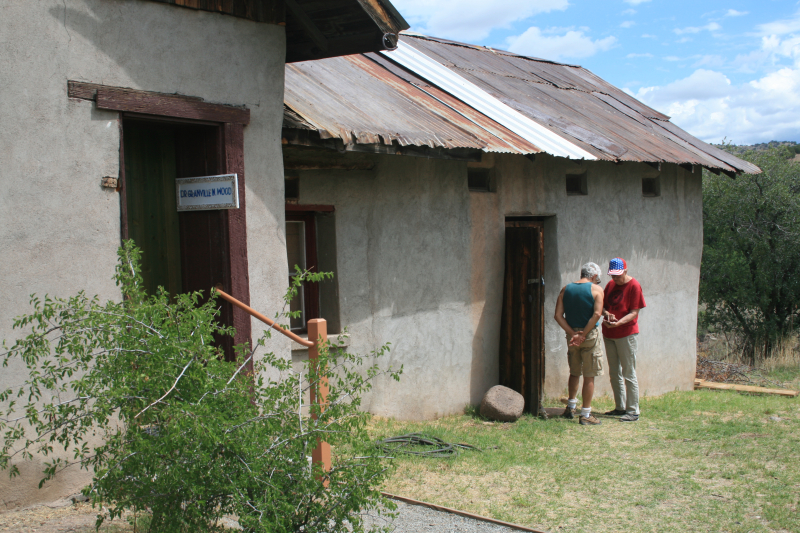
Our final field trip report in this 5-part series addresses the GCAS’s visit to the Mimbres Culture Heritage Site (MCHS) on July 7, 2019, to examine the artifacts comprising the Croteau Collection in a special one-time-only exhibit.
Decades ago the Croteau family owned property in the Mimbres Valley where the remains of a Classic Period (1000 CE-1150 CE) multi-room pueblo was located. Prior to the passage of the 1990 federal Native American Graves and Repatriation Act, it was legal for the family to excavate artifacts and other archaeological materials on their own land. They amassed a substantial collection of Mimbres ceramics, tools, and other items from this site.
Today, the Gila National Forest and the Archaeological Conservancy own the land on which this site, now called the Elk Ridge Site, is located. A significant portion of the site is endangered by seasonal flash-flooding so in recent years professional archaeological crews have performed salvage excavations there. In addition to their scientific research they have taken steps to protect the site from further flood damage. Volunteers currently monitor the site for threats from natural causes, looting, and vandalism.
In late 2018, a Croteau family member wished to repatriate some of their artifacts to the Mimbres Valley from which the family had removed them. Thus the collection was donated to the Imogen F. Wilson Educational Foundation (IFWEF), the owner/operator of the MCHS. The GCAS has been helping IFWEF find an appropriate, permanent home for the collection while it is kept off-site from the MCHS in a secure, undisclosed location.
Upon inspecting the collection in 2019, one archaeologist, who in 1989 had examined a photograph of an array of Mimbres pottery displayed in the Croteau home, instantly recognized one of the bowls that bore a striking anthropomorphic image. It is always expected that such exquisite pottery would have been sold to a wealthy anonymous buyer soon after having been unearthed. Now cradling the bowl in his hands, the archaeologist said, “After 30 years, I thought I’d never see this again.”
Researchers are already studying the items and it appears certain that the Croteau Collection will yield important scientific evidence for years to come. The GCAS commends those Croteau family members who took the time and went to the expense of bringing this portion of their collection back home.
[Photos by M.Smith]