To read the full narrative of the great GCAS field trip of May 2-4, 2018, see all 6 parts of the adventure. I have been remiss in not disclosing that our group dined – and well – while in Mexico. No photos were taken of the excellent seafood restaurant our guide Luis introduced us to in Janos; but we had a more traditional lunch experience in a small hotel in Mata Ortiz that had little trouble in providing our group of 16 gabachos with a classic lunch of chiles rellenos, tacos, and much, much more. (h/t Marcia Corl for the dining photo!)
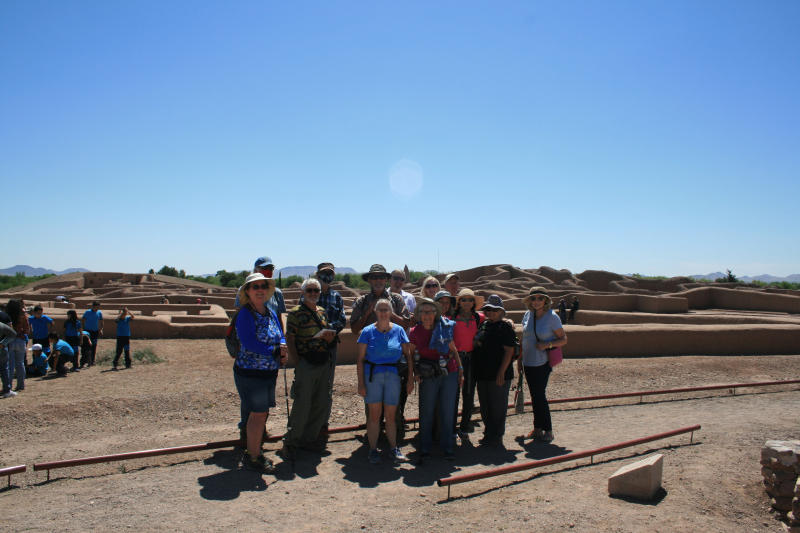
Day 3: May 4, 2018. We arrived in Paquimé. The site’s thick adobe walls may be slowly dissolving back into the earth, but it remains an awe-inspiring sight to look out over Paquimé’s grand plaza, its ceremonial structures, and its residential areas comprising some 1700 rooms.
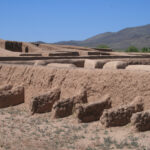
Archaeologists determined that Paquimé was first settled about 400 CE when people began living in pithouses (see photo, left) near reliable sources of water and the land they were farming. During the following centuries from about 950-1200 CE the pithouses were gradually discontinued and covered by surface structures as the Paquimé settlement grew in size. It appears that a succession of three villages were built here, one on top of the other. At its zenith from about 1200 CE to its abandonment in 1450, Paquimé’s structures included heavily reinforced walls and floors of multistory residential units, a walk-in water well, water reservoirs placed strategically around the village, paved canals to deliver water to and from the residential units, pens for breeding macaws and turkeys (above photo), and even three Mesoamerican-style ballcourts.
The first archaeologists who excavated Paquimé in the late 1950s-early 1960s concluded that, given the vast quantities of goods and materials they discovered such as ceramics, macaws, turkeys, copper, turquoise, and millions of seashells, Paquimé must have been a significant regional trading hub. In contrast, current archaeological opinion tends to view Paquimé as a trading village that nevertheless may have manufactured and kept many if not most of its valuable goods for its own consumption. The view is that it may have been less of a trading hub and more of a ceremonial center that attracted travelers from other villages to it.
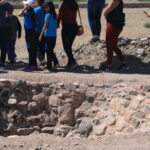
In order to preserve the ruins as well as possible, visitors are now prohibited from climbing on the structures. Certain excavated areas are entirely off limits and can only be viewed from a distance. Other areas have been backfilled or have remained unexcavated. Nevertheless a visitor can get a strong sense of Paquimé society and the work and rituals that were performed here. For example, our group spotted at least three enormous roasting pits for agave throughout the site, suggesting that a large number of people were involved in the events associated with the product’s preparation and presentation – perhaps an even greater number of people participated in the activity than the total population of Paquimé itself would have been.
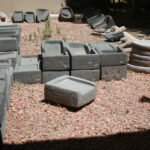
Paquimé’s museum is well curated with artifacts actually excavated from the site. On display are not only the collections of exquisite ceramics and seashells, and artifacts of copper and bone; but also large quantities of manos and metates, plugs to the macaw pens, and stone lids to ollas and cisterns that archaeologists excavated from Paquimé’s many structures. I imagine each person in our group would highly recommend to anyone to travel to Paquimé to learn about the history and culture of Paquimé that is reflected throughout the entire Chihuahuan Desert region – on both sides of the border. Go now!