One of the fun aspects of studying petroglyphs is that regardless of how you interpret the images, nobody is wrong and everybody is right. Following, then, are pics of some of the petroglyphs our GCAS group saw on our March 3, 2019, field trip to Indian Wells.
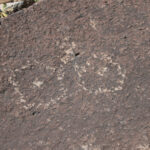
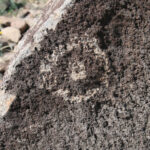
Author Alex Patterson identifies this circle-with-a-dot over there on the far left as a symbol for the moon. Others describe it as a symbol for the sun. Either interpretation seems reasonable but it gets complicated when considering the near-left image. Two moons? Two suns? One of each?
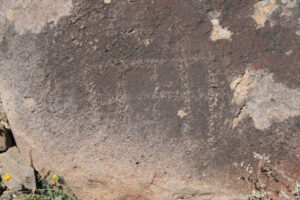
Here, we see an image of a grid. Archaeologists variously interpret this as a fence to keep animals either in or out of an area; or it could be a net for hunting/fishing; or maybe it’s a layout of a pueblo as seen from above. Again, all are reasonable interpretations. But then, how does one interpret a similar grid, but with dots in the middle of each square, as we saw in this same area? Perhaps if one assumes the grid in this photo is a fence around sections of a field, maybe a grid with dots indicates a fenced field that has been planted. Or not. Could both images possibly depict rooms of a pueblo, with the pueblo rooms in the left photo being unoccupied but each room in the pueblo on the right being occupied by one person or one family? Could this be an archaic version of a census?
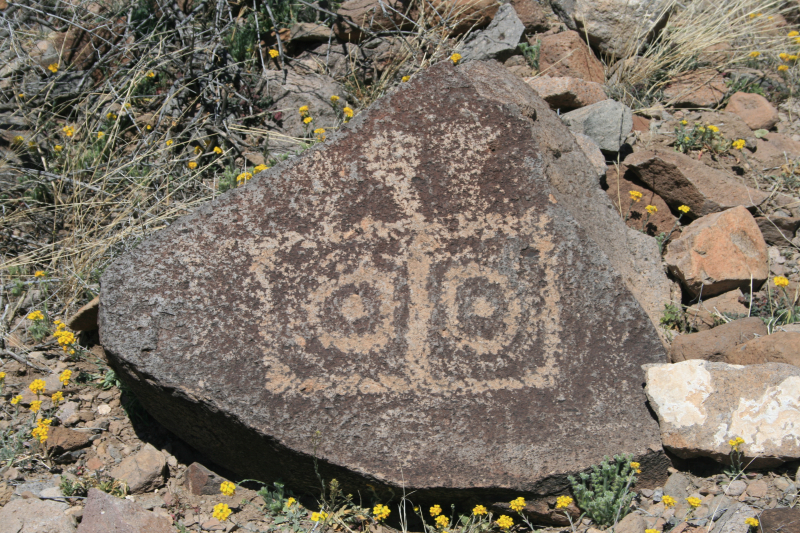
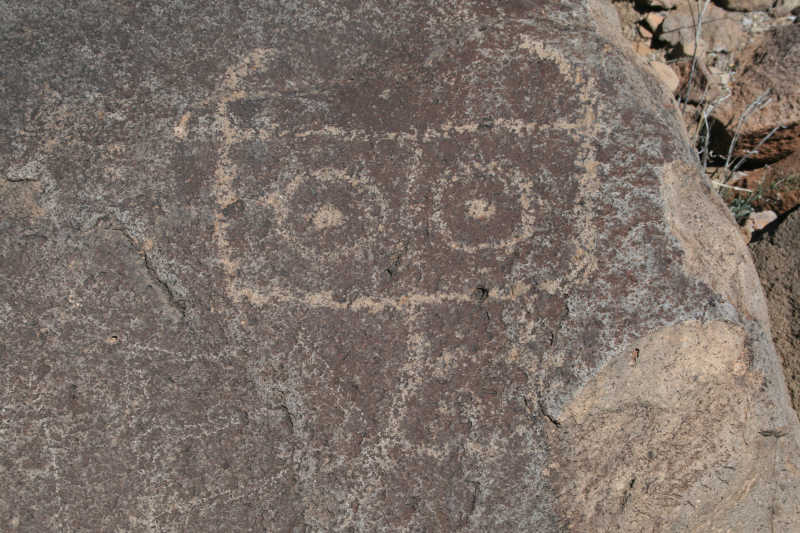
Next, we have an image on the left of what appears to be an anthropomorphic head with large eyes and some kind of antenna sprouting from the center of the head. That might be interpreted to be a symbol of the Mesoamerican rain god, Tlaloc. Alternatively, it could symbolize the staring eyes of Death. However, the image on the right shows what appears to be the same head with the same kind of eyes…but this image shows a pair of curved horns on the sides of the head. It has been suggested that this depicts an owl species local to the US Southwest with ear tufts, such as the great horned owl or screech owl. If so, does the image on the left depict a local owl that has no ear tufts, like the spotted owl or pygmy owl? If so, how does one explain the antenna? What are your ideas?
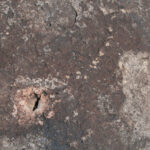
This last image is of one that has used some natural features of the underlying rock to create what I, personally, believe is a depiction of a celestial event. Observe how a natural hole in the rock was pecked around, to give the effect of luminescence, with additional pecking that arcs to the right and upwards in a series of dots along a sharp edge of the rock. Sure looks to me like a comet and its tail. Specifically, Halley’s Comet. Which we all know returns to our area of the universe every 75-76 years. Meaning our petroglyph artists might have seen it in the sky in 936 CE…1011 CE…1087 CE…1162 CE…
Of course, reasonable minds may differ. And bad ones seldom do.