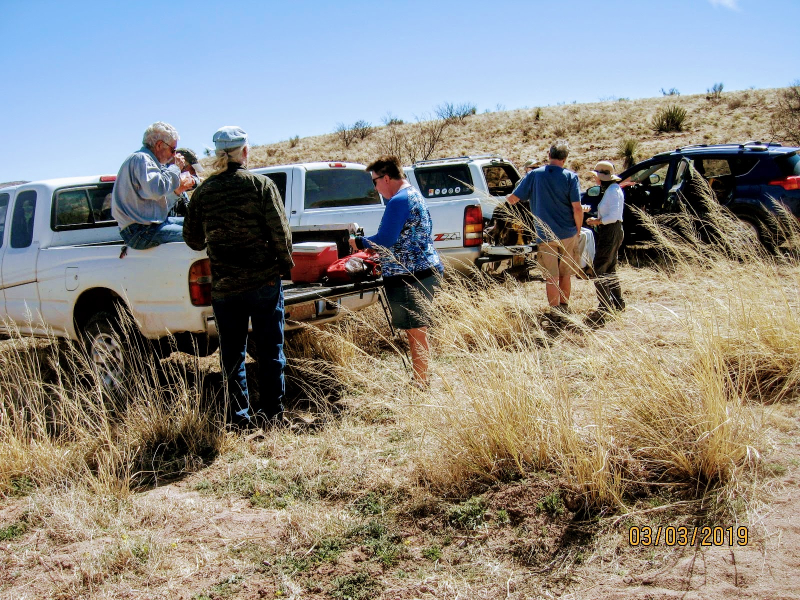
Please welcome today’s guest photographer, GCAS’s own Chris Overlock. Thank you for sharing your photos, Chris!
Chris was one of 11 humans accompanied by 2 enthusiastic canines on our March 3, 2019, visit to three archaeological sites that comprise Indian Wells in southwestern New Mexico. Two of our group had come all the way from Las Cruces to join the fun. High-clearance vehicles carried us over increasingly rough roads to a point from which we could reach our intended sites on foot. The weather was breezy but otherwise just right for exploration.
Grazing cattle kept wary eyes upon us as we climbed to the top of a low, flat ridge to find the faint outlines of several pit houses. It was clear from the scattered rocks and absence of certain surface artifacts that regular looting had taken place during past decades and was continuing, so it was difficult to pinpoint the pit houses’ age within the broad range of 200 CE – 1000 CE. Casual “collectors” had removed all surface potsherds from the site except for fragments of corrugated and plain ware.
We left the pit house area and climbed to a higher ridge nearby. Here we found the badly-looted remains of a small pueblo but it was difficult to locate any foundations or other original features due to the heavy bulldozing one or more persons had done in the past. Adding insult to serious injury, visitors here have been continuing to gather any and all surface potsherds that catch their eye, as they have been doing at the pit house site.
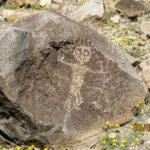
Our final destination was a cluster of petroglyphs about 1/2 mile away through cattle pasture and fields of sacaton and datura. Roughly half of the petroglyphs were very faint, suggesting they may be quite old. Some of the more recently-pecked images diverged from those we typically see in the Mimbres Valley, although many others shared a common theme. Sadly, some 21st-Century visitors have scratched their own work into the rocks as well.
Despite today’s heavy cattle grazing and the clear signs of vandalism and looting, the trip was worthwhile for the GCAS. We explored an area of picturesque low ridge lines and a convenient watershed that for centuries had supported a population of hunters and farmers. It was easy to understand why people chose to make this place their home for so many generations.